Showing posts with label Sermon. Show all posts

Saturday, July 27, 2013

Life in a Graveyard

(A sermon preached at Central Christian Church (Disciples of Christ) in Dallas, TX on July 28th, 2013)

Rick Wienecke and Casting Seeds (http://www.castingseeds.com/drybones.html)

The sad truth is, a story told over and over can cease to captivate us.  That is especially true for those of us who have heard stories in the Bible year after year after year.  We have stopped being shocked, angered, grief-stricken, overjoyed, humbled or captured by the stories of our faith.  And when that happens, we have to open our hearts to hear old stories in new ways, with new words.  Which is why, this morning, I ask that you listen while I try to retell you one of those old stories.  May the words I have written and the meditations of my heart be acceptable to you, O God, my Lord and redeemer.


Ezekiel had thought that he was done being surprised by YHWH. He had once found himself whisked into the inner sanctums of the temple in Jerusalem though he had been 200 miles north only seconds before. He had been struck mute for years, the only words that passed his lips being sharp words of judgment. He had watched his wife die and then had been forbidden to mourn her. He had eaten bread cooked over cow shit, had crawled through holes in walls while confused crowds watched him. If it was possible to get used to the impossible, Ezekiel thought that he had gotten used to it. But now he knew the folly of that presumption as he stood knee deep in the dry bones of what seemed to be an entire nation. Where the hell was he?

These people (a whole people?) had been dead a long time. The bones had none of the shiny luster of a fresh kill, and there was no smell. The wind whipped through rib cages and macabrely delicate hand bones and there was no smell - except maybe for the faint aroma of dust.  These folks had been picked clean and their marrow had been sucked dry and all that was left were their brittle bones like cracked carapaces.


Ezekiel tried to pick his way out of the middle of the sea of skeletons he had materialized in. He was haunted by so many scenes of terror and violence, his dreams a shrill and screaming cacophony of nightmares already lived and nightmares only feared, but he still looked quickly away from the tiny skull that could only have belonged to a baby. He tried to unsee the small hands clutched in the bones of larger ones, tried to avoid the postures that hinted at loved ones dying alongside one another. These bones were old and dry but they still told a tragic story, a story of devastation and destruction and the implacable march of time that bleached them white.


He tried to make his way to the edges of the graveyard valley but seemed to be trapped by the unmoving figures strewn about him. He closed his eyes and took a deep breath, preparing to fling himself in a random direction, when he felt a hand slip into his own.  Ezekiel's eyes popped open in fright and then he stilled when he realized who was standing next to him. The first time the figure had appeared, Ezekiel had tried to get a good look at the face hidden by the deep white cowl of their robe, but he could never remember what he saw there. (A face? The starry skies? The dark vastness of the tumultuous seas? All that was and is and will be?) He let himself be led through the bones.


They came to the edge of the valley of bones and looked on it together. Ezekiel braced himself for another volley of gorgeously phrased judgments, but the figure to his right merely gestured expansively to the graveyard scene below them and asked with a voice both whispering and thundering: "Human one, can these bones live again?" Can these bones live again? Was that rhetorical? A test? Ezekiel was still not used to being able to speak by his own choice and he was deeply shaken by the desolate scene laid out below him. How could he have words in this place of death, let alone words of life or hope? Can these bones live again? He decided to deflect with what sounded pious but was really laden with confusion and pain: "Lord, You Know."


He was afraid he did know and that the answer was no and that this was just one more depressing vision about the fate that awaited Israel after God brought down full judgment. His people, his wife, his children, his nation, himself, prone bones in a valley of death, an object lesson for the ages. "Lord, You know."


The figure moved from his right and stood in front of Ezekiel and took his face into its hands (or were they furling clouds? Or the great stones of the Sinai desert mountains?) and spoke gently to him. It was the voice that mothers use with suckling babes or shepherds use with frightened lambs. It was a voice that the Hooded One had never used with him before. "Prophesy to these bones, Human one. Tell them that I will soon breathe life into them and they will live again. Muscle and sinew, nerves and skin will grow again and they will live."


Oh, how he had longed to speak words of life after so many years of only speaking words of death! The Hooded One stood beside him again, patient (such a patient One), seemingly unmoved by the open tomb below them and motioned him forward. So with a soft voice, choked with tears unshed and hope so long unspoken, Ezekiel whispered a trembling benediction over the valley of dry bones: "Bones, you shall live."

The clatter that arose out of the valley was one that Ezekiel would never forget.  It seemed to be the sound of a thousand blades crashing together, of the waves of the Red sea roaring up and over the armies of Egypt, of the loud songs of the temple during the golden age of Solomon, of the thundering of rocks as they rolled down the sides of Mount Horeb.  Dust swirled below, but he could clearly see the bones rising up from their resting positions and…assembling.  Feet connecting to ankles to leg bones to femurs to hips to spines to arms to necks to skulls, a skeleton army that stood unmoving in the sudden silence. 

And then, the air was filled with a wet sound.  Ezekiel had no idea what could make that sucking, swirling noise so he raced back into the midst of the bodies and watched as sinew and vein, nerve and muscle grew up and around and through the once-dry-bones.  He watched hearts begin to grow and eyes fill in the sockets and tongues lay down beside now glistening teeth.  He marveled as skin grew up and hair grew out and all at once a nation of people stood where there had been only death.  He would have shouted with welcome but he suddenly realized that they didn’t breathe.  He felt the neck of a man close to him and he could feel the pumping of a newly made heart.  But they didn’t breathe.  They were statues made of flesh.

Ezekiel looked to the ledge that he had just run from, seeking the answers that only the Hooded One could give.  As usual, the cloaked figure was never where Ezekiel expected it to be.  This time the voice (was it weeping? Or singing?) came from his left, weaving a path in and out of the still standing figures.  “Call to the four winds, Human one.  Tell them that the Lord bids them to come and lend their breath to those that were slain so that they may live. “  Ezekiel ran into the midst of the still bodies, ran until he reached the middle of the great (and silent) multitude and threw his hands and voice up into the air with exultation: “Come winds of the North! Winds of the south! Winds of the East! Winds of the West! Bring your breath, that those who were dead may once again live!”

And the winds came.  With a thundering fury, the winds spilled into the valley and swirled around the silent figures.  Ezekiel was buffeted back and forth, blinking furiously as the powerful winds from every corner of the earth rushed and pulled at him.  Shielding his eyes and struggling to make his way through the tightly packed bodies around him, he strained to see what was happening.  He finally reached the edge of the assembly and he saw, all at once, all of their mouths fall open: the mouths of babes in arms and withered old men, the mouths of strong young men and pregnant women, the mouths of the young and the old.  They opened their mouths and as one their chests heaved and swelled with their first breath.  They lived! They lived!  He had spoken the word of the Lord and they had lived!

Ezekiel watched with joy, anticipating their first words, their life, (their possibility!) when he felt himself being jerked around and then swallowed up by the fabric of what seemed to be a very large white robe.  Strong arms (or were they the trunks of great trees?  Or thick vines from plants unknown?) held him close and the Hooded One spoke quietly into his ear: “Human one, these bones are my people Israel who cried out to me when all hope was lost.  Prophesy to them, tell them that I am the God who opens graves and restores life to the dead.  Tell them I will open their tombs and bring them up and they shall live again.  My spirit shall be within then, with you.  You shall live again.”

And Ezekiel wept in the arms of the One he loved, of the One who loved him.  Wept because his people would one day live again.


Hear the words of the Lord, my beloved.  God has given you his spirit, and you shall live.  God has breathed upon you, so you will live.  Out of the graves of your past, out of the tombs of your sin, out of the mausoleums of your failures, God calls you to live.  Stand up you who were once dry bones.  Stand up.  And live.

Sunday, December 16, 2012

For a day such as this

The following is the text of a sermon I preached today. My scripture was Matthew 2:13-18.
---
In the first and second chapters of Exodus, we read a violent and terrible story of an evil pharaoh whose fear and need for power leads him to murder babies. The command goes out that every baby boy born to the Hebrews should be thrown into the Nile to drown. And Moses’ mother hides him for three months until in an act of desperation and breathless hope, she fashions him a tiny boat and floats him down the Nile. It is a terrible world indeed where a three month old child is safer in the waters of a Nile than in the house of its parents. A terrible king. A terrible world.

Lord have mercy. Christ have mercy.

In the second chapter of Matthew, we read a violent and terrible story of an evil king whose fear and need for power leads him to murder babies. The command goes out that every child under the age of two in Bethlehem should be killed. And Jesus is spared only because an angel of the Lord appears to Joseph in a dream and warns them to flee to Egypt. It is a terrible world indeed where a child is safer on the run and in exile than in the house of its parents. A terrible king. A terrible world.

Lord have mercy. Christ have mercy.

On Friday, we read and heard and watched the violent and terrible story unfold of an evil man who murdered adults and children in an elementary school in Connecticut – 20 children between the ages of 6-7. It is a terrible world indeed where a child is not safe in an elementary school. A terrible man. A terrible world.

Lord have mercy. Christ have mercy.

And today is the third Sunday in advent and this is supposed to be the Sunday of Joy – when we remember the angels who appeared to Shepherds who were watching their flocks by night and sang a song of exultation that our King had come. And maybe you are like me and feeling as far from joy as dark is from light. How can we possibly feel any joy when we see the faces of our children and fear clenches our hearts? How can there be joy in a world where children are murdered in elementary schools in Connecticut, in their homes in Syria, in refugee camps in the Sudan?

Lord have mercy. Christ have mercy.

Our poets have long been lamenting the sorrows of this world, and as I've been laid low with grief by this tragedy, the words of William Butler Yeats came to me: Things fall apart; the center cannot hold; mere anarchy is loosed upon the world, the blood-dimmed tide is loosed, and everywhere the ceremony of innocence is drowned. The poet Jeremiah, in his Lamentations, says words that ring very similarly as he lives through the destruction of Jerusalem: My eyes are spent with weeping; my stomach churns; my bile is poured out on the ground because of the destruction of my people, because infants and babes faint in the streets of the city. They cry to their mothers, ‘Where is bread and wine?’ as they faint like the wounded in the streets of the city, as their life is poured out on their mothers’ bosom.

Lord have mercy. Christ have mercy.

Many have been quick with words for the tragedy of this last week – claiming to know the mind of God, the will of God, the purpose of pain, the causes and solutions to this present darkness. Well meaning folk make God an idol of child sacrifice with careless words and misread scripture. Well intended people use tragedy to bolster pet arguments or silence dissent. And many of us sit in stunned quiet, our wounded spirits crying out at the spilling of innocent blood, in voices like the martyrs of Revelation: HOW LONG, O GOD?! HOW LONG?!

Lord have mercy. Christ have mercy.

I do not have an explanation for what has happened. I know of no reasons, of rational explanations, of sure-fire steps to be taken to prevent further tragedy. I refuse to take this pain from you with easy answers and theological chloroform; children are dead and their bodies are still in the classrooms where they were murdered and Christmas is in 9 days. And today is the Sunday of Joy. And somehow we must hold our grief in one hand and this Advent season in the other and discover a way to negotiate them both. Somehow we must hold our children close and then send them to school.

Lord have mercy. Christ have mercy.

This is what I can say to you. Jesus was born not because the world was so good, but because the world is so broken. The Christ child came not because it was the perfect setting but because the times are terrible. The Messiah entered the world by way of a teenage mother in the company of livestock because we needed to be saved and He is the only one who can save us. The bliss of his birth was followed closely by unspeakable evil, which only served to underscore HOW MUCH WE NEED THIS CHILD. And adds depth to the songs of the Angels who sang: I am bringing you good news of great joy for all the people: to you is born this day in the city of David a Savior, who is the Messiah, the Lord.

There is joy to be had in this day, and it is nothing like the easy happiness of fortunate times, of full bellies and safe homes and absent violence. The joy in this day is that violence and terror and loss and grief and murder and evil and injustice and inequality and hatred and malice – they are not the final word. The joy in this day is that the story we are hearing, of lost innocence, is not the STORY that God is ultimately telling in Jesus Christ. That God sees our suffering and is DOING SOMETHING ABOUT IT through the birth, life, death, and resurrection of Jesus Christ. That we are more than just grieving family and friends but the community of the Church who have been empowered to go out into a dark and broken world with the GOOD NEWS of JESUS.

Our Joy is that the people languished in darkness for centruies but that the light finally came.  That a young girl could sin a song about God, a God who shows His mercy is for those who fear him, who scatters the proud in the thoughts of their hearts.  Who brings down the powerful from their thrones, and lifts up the lowly; who fills the hungry with good things, and send the rich away empty.

Our Joy is that God is with Us. When we attend funerals and cry over tiny coffins. When we rail against violence and political apathy. When we search for answers. When we ask impossible questions. When we take a stand against evil. When we sacrifice for the sake of others.

Our Joy is that God is the center and God will always hold, that the kingdom cannot be drowned, that anarchy is not loosed forever.

Our Joy is that Emmanuel was born, is about to be born, is coming, will come again.

Lord have mercy. Christ have mercy.

Thursday, April 30, 2009

Baptism Sermon

For my theological capstone class on Baptism, I was required to write a sermon. Only caveat? It had to be on baptism.

So the following text is based off of Matthew 3:13-17. Let me know what you think
---
He stood amongst the crowd that had gathered to listen to John, watching as they recoiled and reacted. John had always been good at this, the controversy, the bizarre appearance, the fiery words. John had already hit his favorite lines, calling the Pharisees and Sadducees vipers, the bit about Israel being a tree cut down, the brutal swipe at what it meant to be a child of Abraham. John was in good form today, pacing and frothing, fingers pointing and voice rising and falling in thunderous crescendos. The family had stopped wondering where John learned all this; the speeches, the clothing, the gaze that never looked at you but always through you. He should have been a priest; he was after all, from the line of Aaron and Abijah. He should have followed his father into the temple but had wandered out into the wilderness instead. And now…well now John was as He saw him. Wild John, the man who wore camel hair and ate bugs. And claimed to be preparing the world for something. For someone.

He stood amongst the crowd that had gathered to listen to John, watching hardened hearts break, watching the waters part and then swallow up person after person after person. This was the Jordan after all; Israel had crossed it once to enter into their new land. Why not cross it again and enter into new life? He smiled to think of his namesake: standing on the banks of the Jordan, looking back at the people of Israel as they grumbled and mumbled, telling them “Let’s go people. God is even going to part the waters for us. Again.” Poor Joshua. Joshua knew what it was like to remind people about who God was and what he’d done for the people of Israel. Joshua knew what it was like to call the people back from the crooked roads onto the straight path. And once again a man of God was standing on the river bank “Let’s go people. Repent. Let’s get on the straight road again. He’s Coming.”

He stood amongst the crowd that had gathered to listen to John, watching the people give each other confused glances, watching the people give each other alarmed looks. “Prepare the way of the Lord?” It was hard to believe that God was on any road, coming anywhere near Israel. He’d been silent for so long; he had given over Israel into the hands of her enemies. Why show up now? “But after me will come one who is more powerful than I.” Even stranger. Is there some group of wild men out in the deserts of Judea, all uniformed in camel hair and leather, staging a religious coup as we speak? Is John implying that he’s powerful? Compelling, maybe. Powerful? Who is this one he speaks about? Will we know him when we see him? He watched them as they turned to one another, “…whose sandals I am not fit to carry.” Is the one coming some sort of Lord that he can’ carry his own sandals? How low would you have to be to be unfit to carry sandals? Who is Coming? Who is he speaking about?

He stood among the crowd that had gathered to listen to John and remembered the stories they’d been told over and over and over again about the days of their birth. Angels and wise men following stars, shepherds and barren women and virgins and fleeing to Egypt. Dreams and temple dedications and Anna the prophetess and kind, old Simeon, portents of great things to come. And then the days after those stories. The normal, boring, regular days in temple and at home, in the shop with Joseph. The steady stream of typical days of family dinners and sibling squabbles and aching muscles as He learned Joseph’s trade. And then the days that had become strange again. When John had disappeared from the family gatherings, and old Aunt Elizabeth whispered mysteriously, “I always knew he would…I knew he would.” When He himself had begun to feel the burden of the future pressing down on him, when he himself began to think about what was to come and unexplainably, knew. The days when he walked around Nazareth and talked with his neighbors and knew that soon things would change, and that there would be a day when he was no longer welcomed here. The days when his mother Mary would walk into the shop and grab His hand and just stare at him. Stare at him like something was going to happen to him and she wanted to remember him forever as he was in that moment.

He stood among the crowd that had gathered to listen to John and breathed deeply. In much the same way the John had been driven out into the desert, He had been driven here. This wasn’t the first time that John had preached his fire and judgment at the Jordan. John had been preaching for days now and the discussion around the family was whether or not they should go. Elizabeth would have gone if she had been alive still, and Mary would have come if her life had not already been plagued by scandal. Joseph kept silent about it, as he did in most things. His brothers and sisters had laughed it off, regretting that cousin John had turned out to be one of those ‘crazy men’ who plagued Israel in these days. But He, He could not stay away. The Jordan called to him as it must have called to the tribes all those thousands of years ago. And after days of thinking about praying, today He had come. Expecting everything and nothing, knowing only that today something was going to happen. And that everything would change.

He stood among the crowd that had gathered to listen to John and began to move to the front of the group. He passed Pharisees and Sadducees, soldiers and publicans, priests and tax collectors, prostitutes and widows. He threaded his way through families with small children, and around rabbis with their groups of disciples. He moved through the crowd in silence, seeing all around him but hearing the ceaseless call to come forward, to see John. The water was calling. God was calling.

He came out from among the crowd that had gathered to listen to John and stood on the banks of the Jordan. And John, between impassioned cries for repentance and the condemning judgment of God, saw him. To the crowd, the silent stare shared between John and the stranger was brief. Strange, but brief. But for John and He, the moment stretched out like pulled glass – vivid and fragile and never to be recreated. In the time between sight and speech, John’s world collapsed in on him and then expanded again, realization and shock stealing his words, hope and fear throttling his breath. The words that he had been preaching had somehow manifested themselves, the road that God had been traveling on unexpectedly crossed the Jordan. John saw Him standing at the river bank. The man had an axe in his hands, ready to sever the root. No, he was holding a winnowing fork. No, he was blazing in the fire, the Shekinah Glory that only Moses had ever seen. And suddenly the visions were gone and the shock was even greater. Him. It was Jesus. And he was wading into the Jordan river towards him.

He waded out into the river in front of the crowd that had gathered to listen to John. And when he reached him, John’s face grew white and his voice shook. “I need to be baptized by you, and do you come to me?" The crowd could no longer hear what was being said, and so they strained in closer, crowding the banks of the river, hoisting children upon their shoulders. They knew the scene had changed, the play had a new character, and they wanted to see. “I need to be baptized by you, and do you come to me?" John, face to face with that which he had been so long preparing, was no longer wild. Jesus knew this John, the contemplative, devoted, God-fearing John. The John who wrestled with the pronouncements and laments of the prophets, who wept when he broke the laws, the John who prayed without ceasing. He reached out and grabbed John’s shoulder and spoke with authority that younger cousins never have. “Let it be so now; it is proper for us to do this to fulfill all righteousness.”

He stood in the river in front of the crowd that had gathered to listen to John and waited. “Let it be so” John whispered. He knew righteousness. The difficult and beautiful road that one traveled in obedience to God. The suffocating and liberating life that fulfilled all the laws. He also knew that righteousness was absent from this world, or at best, fragmented, perverted, cast aside. John craved righteousness, craved for the return to God, craved shalom that only comes when Israel was once again in full covenant with God. “Let it be so” Jesus whispered back. His road had been leading here for so long. He had seen this river many times, stood on it’s banks for hours, recounting the stories of Joshua and Israel. He had bathed in it, played in it, crossed it countless times. But now, the Jordan was no longer the river of his childhood – the Jordan was the road that stretched out before him. The Jordan was the beginning. “Let it be so…” they whispered together. And John baptized him.

Jesus rose up out of the water in front of the crowd that had gathered to listen to John and the heavens tore themselves apart. Jesus looked up at the sound and saw the Spirit of God descending like a dove and it lighted upon him. It was like new wind, the breath of a newborn child, the rushing winds of the high mountain ranges and the whispered wind currents of the low valleys. It was like fire and ice, like the deepest darkness and the brightest of flames. It was like meeting your father for the first time and then realizing you always knew him. He was frozen like a pillar of marble, eyes gazing up into the heavens, shrouded in the spirit. The crowd was panicked, standing frozen with Him, fleeing from the river banks, shouting and arguing with one another. People who desire signs never really want them. John was still touching Jesus, his hand cradling Jesus’ neck, afraid to let go of that for which he had always hoped. The tearing of the skies was almost secondary to holding on to the promised One.

And a voice from heaven said, "This is my Son, whom I love; with him I am well pleased." John’s hand dropped from Jesus and he shook, trembled in fear and joy. The crowd fell to their knees, awed by the voice that they had so long craved to hear. And Jesus wept silent tears. Tears of joy for the final confirmation, the proud announcement, the knowledge that there were no more secrets. Tears of fear for the days to come, the misunderstandings, the challenges, the tribulations and persecutions. Tears of despair for where the road ahead would take him. For the fact that Sonship was costly. Silent tears that no one saw because their gaze was either to the heavens or to the earth. “This is my Son, whom I love.” It was one thing to hear Mary say it. And another to hear Joseph, silent, righteous, Joseph say it. This, this was full and deep, terrifying and completing. “With him I am well pleased.”

Jesus stood in the river in front of the remaining crowd that had gathered to listen to John, dripping wet and full of memory. He was the earth the moment that the seas had been made. He was Noah in the ark, saved from the deluge by God’s provision. He was Israel escaping Egypt through the waters of the Red sea, following fearfully behind Moses. He was Joshua standing at the Jordan. He was Elijah when the rains finally fell again. He was Namaan, healed and rising out of the water of the “mere” Jordan river. He was the wet fleece of Gideon’s, the sign of God’s promises. He was Israel, washed clean, over and over and over throughout time. He was mankind, purified, sanctified, set apart. The waters dripped from his nose and fingertips, his soggy clothing draping wetly across his body. And John wept silent tears. Tears of joy for the faithfulness of God and his promises. Tears of fear for the days ahead not only for himself but for his cousin, his Jesus, the promised ones. Tears of despair that he was not the long awaited one and would ever point to another. For the fact that Sonship is costly. Silent tears that no one saw because their gaze was either on Jesus or on the horizon as they fled the scene.

Jesus stood in the river in front of the few remaining who had gathered to listen to John, and turned towards his cousin. This would be the last time they saw one another, though neither could know that. John, Wild John in his camel hair and leather, Jesus, the Promised Jesus, in his soaking tunic. They stood in the river with each other, in silence and all the heavens and earth looked on. The time was finally come. The long years of waiting, the long silence of God, the fear that nothing would ever change…all done. Through the triumphs and tragedies, through failed kings and false priests, through exiles and judgment, through homecoming and rebuilding, through revolution and subjugation, God had been working, plotting, maneuvering, planning. Through the cries for mercy and mocking denials, through false messiah’s and puppet rulers, through despair and hope, God had been moving. And here, in the middle of the river that ran through Israel’s memory and heart, here two men, two cousins clasped each other.

It had begun. And all the world would be changed.

Thursday, April 9, 2009

Maunday Thursday Sermon

It's been awhile, but that's life I guess.

This sermon is a bit of a departure for me stylistically. Let me know what you think!
------
The world being as it is, it’s not hard to imagine dark times. We’re all traveling through our own shrouded worlds tonight – some of us who’ve lost jobs. Some of us have lost our houses. Some of us have lost our spouses, or our parents, or our children. Some of us are just overwhelmed by complications that we never knew would be a part of this life. Everywhere we turn we see bad news, collapsing companies, missile testing, earthquakes, famine, war. And everywhere we see talking heads spelling out our doom but giving us no hope, no answers, only more questions. Our future is uncertain, our categories are jumbled, our leaders seemingly powerless. It is a dark night indeed.

When Jesus gathered his disciples together for what he knew would be their last Passover, it was a dark night. Though they shared cup and loaf, jokes and familiar stories, prayers and songs, I imagine that Jesus looked deep into the shadows of that room and saw what had already come to pass and that the dark night that was stretching out before him.

When Jesus was hanging from that bloody tree and his disciples had scattered to the four winds, when the only cup that was offered him was vinegar, when the only laughs shared were mocking daggers piercing his already tender flesh, I imagine that he looked deep into the shadows of the men’s souls who surrounded him and saw again the dark night that he knew not the end of.

It is said that when people are on the edge of death that their lives flash before their eyes, that their mind replays for them the seemingly significant and insignificant events that have made up their lives, a sensory overload before all senses cease. It is not hard for me to believe that while on the cross, Jesus’ life flashed before his eyes – the crowds begging for food, the demon possessed, the sleepless nights, the shared meals, the fights in temples, the tender moments when children came forward to him in love.

It is not hard for us to flash backward through the stories of the life of Jesus, remembering his joys and sorrows, his beginnings at this terrible end. So throw back your minds and imagination with me to one of those first stories and how it shaped our Jesus. Come with me to the desert.

He had just been baptized by his cousin John, and a voice from heaven had proclaimed his identity to the whole world “This is my son, the beloved. In him I am well pleased!” In his joy and fear he had done what God commanded and then, inexplicably was driven into the desert. He only knew that his Father desired him to be there and so he wandered. Day and night through parched lands, no food, little water and silent suffering. Interminable silence only broken by the gusts of harsh winds and the scuttling of unclean creatures. 40 days in silence, in hunger, he waited.

And then a stranger appeared. With smooth words and scriptures the stranger tempted him. “If you are the Son of God, change stones into bread.” Be a Messiah of Bread. “If you are the Son of God, throw yourself off of the temple mount.” Be a Messiah of Signs and Wonders. “If you are a Son of God, bow to me and receive the kingdoms of the world.” Be a Messiah of Military Power and Conquest. Each time he denied the stranger and his temptations. Each time he denied the temptation to be another kind of Messiah. And so the stranger left him. Temporarily.

Perhaps this is the image, the scene that our dying Lord saw before his eyes as he hung, beaten and dejected upon that tortuous cross. Certainly the scene before him seemed very similar.

When we imagine this story, we tend to see our Lord on a cross on a hill somewhere, with murderous crowds circling beneath him like beetles. But truly, to the world, his death was no more spectacularly different than the death of thousands of criminals before him. The bored and indifferent, and perversely obsessed with death swirled around and past his torture, stopping to gape and gab and read the crimes for which he was punished.

This was another desert for Jesus. He was called onto the cross after the joy of entering Jerusalem. He thirsted for water but there was none, he longed for release but time dragged and dragged and dragged. And the only sounds that he heard were the murmurings of the soldiers as they diced for his clothing and the shrieks of pain from those who suffered and died next to him. And then after time immeasurable, the stranger appeared again.

But this time, the stranger was not alone. The stranger stood amongst the crowd that had just days before cheered Jesus’ entrance, who now stood at his feet and mocked him. He commiserated with the priests, teachers, lawyers and elders who saw him condemned, goading them in their jibes towards Jesus. He perched like a vulture on the arm beam of the crosses of the thieves and degraded Jesus alongside them. And tempted him three more times.

Perhaps this seems strange. “Why” you ask “would the stranger waste his time with any more temptations?” “What left is there to offer?”

Jesus was a man and I’m sure like most men, like most humans, the world had much to offer him with. Money, sex, power. But the only real temptations for him centered around who he was, about what he was going to do, about the role he had in the future of all things. Jesus, the Messiah. We know that title. Of course – Messiah! The one who died for us, we say. Simple. What is there to tempt? But we come after the climax and shocking reveal. We know Messiah in hindsight whereas Jesus and all those around him struggled in the midst of it. Messiah? What kind?

These were Jesus’ temptations. Be a messiah of Bread, the stranger offered. A Messiah who feeds us would never end up on a cross. Be a messiah of wonders, the stranger cajoled. A Messiah who calls upon angels would never die a traitor’s death. Be a messiah of armies and conquest, the stranger begged. A Messiah with an army would never be given over to his enemies to die by suffocation. Avoid the Cross….Avoid the Cross.

And so they are his temptations again.

Hear again the word of the scriptures: Those who passed by derided him, shaking their heads and saying, ‘You who would destroy the temple and build it in three days, save yourself! If you are the Son of God, come down from the cross.’ These passers-by mock him. If you are the Son of God, come down of the cross and show us how mighty you are! Destroy the temple? You and what army? If you are the Messiah…come down off the Cross.

Hear the scriptures again: In the same way the chief priests also, along with the scribes and elders, were mocking him, saying, ‘He saved others; he cannot save himself. He is the King of Israel; let him come down from the cross now, and we will believe in him. He trusts in God; let God deliver him now, if he wants to; for he said, “I am God’s Son.” ’ The priests challenge him. “We know” they say “who the Son of God is. The Son of God will be the King of Israel. The Son of God will always have the protection of God. You the Son of God? You, the dying criminal? You, the abandoned one? Some King! Some Son! If you are the Messiah….come down off the Cross.”

Hear the scriptures again: The bandits who were crucified with him also taunted him in the same way. Even the thieves, the men who were dying alongside Jesus mocked him. “Son of God? Since when does the Son of any god keep company like us? Son of God? On a Cross? Condemned and close to death? If you are the Son of God…If you are the Messiah….come down off the cross!”

Be a messiah of might by bringing down the temple. Be a messiah who is king . Be a messiah who is pure and only walks with the righteous. Be a messiah…just come down off the cross! Come down off the cross!

All the stranger ever wanted was for Jesus to avoid the cross. To avoid being the Messiah who dies so that we may live. And once Jesus was on the cross, all the stranger wanted was for him to come down. For Jesus to live so that we would die.

Whenever we tell this story to each other, on nights like these, we like to pretend that we are the righteous few who would not have crucified Jesus. We are not in the crowd that mocks, or the priests who shame or the thieves who degrade. We are certainly not the stranger – come down…come down.

But tonight, of all nights, I think that the time has come to admit something. Tonight. Of all nights, before we once again enact that last supper, it is time to confess. We were the crowd who said “Let his blood be upon us and our children!” We were the priests who mocked him “King of Israel? Here’s your crown!” We were the thieves, unrepentent in our sin even unto death: “You are the Son of God?”

Come down off the cross. Come Down Off The Cross. COME DOWN OFF THE CROSS!

We are desperate, just as the stranger was, just as the mocking crowds were, for Jesus to be a different messiah. We can stomach the savior who feeds us. We can bear the savior who entertains us. We can follow the messiah in all of his might. But we cannot, will not have a messiah who saves us. A messiah who must die to do so. And why?

Because we cannot bear the guilt. We cannot bear the shame. And we cannot bear the truth that it is what we so desperately need.

Letting Jesus be the Messiah who suffers, letting Jesus be the Messiah who dies, letting Jesus be lowest and despised is painful. The pain is that of being stretched, of having one hand tied to the tree which is the cross and the other tied to the first tree, the tree of the knowledge of good and evil. If Jesus does not come down from the cross, we are pulled between these trees, constantly facing our sin, knowing that we chose to eat of the fruit and so Jesus chose to die for our sakes. Because he will not come down, we are ripped apart. We, like the veil of the temple, have been torn asunder.

He would not avoid it. He would not come down. And he died. And so did any of our pretensions that we could save ourselves.

This is a dark night. And perhaps that is on purpose. The dark invades us and finds its own echoes in our minds, our hearts, our histories. The dark calls to dark and we are confronted with our own sin, our own need for grace, our own culpability between the trees.

Dawn will come. The dark will not last forever. But now it is dark.

Tuesday, February 17, 2009

CRASH!

I'm keynoting a youth retreat this weekend in Mesquite, TX and the theme of the weekend is "Hope." I'll be speaking 4 different times, and the topics will be "Jesus is Our Hope "; "Jesus is Our Family's Hope"; "Jesus is the Hope of the World"; and "Hope Begins In Us." Daunting to say the least. And not just because that's four sermons - also because it's a room full of teenagers and I've only ever preached to adults. Ah well...God is good and I trust that He will give me the words to speak into their lives. As I finish up these sermons, I'm going to post them here so you can let me know if my language is too mature, if my illustrations aren't good enough, if there's a video or song that you think might make my point for me. Thanks for your help. And may I ask if you would pray for me this weekend? I desperately want the gospel to be communicated to these youth, and I want God to be glorified in the whole retreat. Your prayer can bolster not just me, but all of the adults who are striving to disciple these youth. Thanks in advance! ::Smile::

So, without further ado, here's the first sermon. I've titled it "Being Afraid of the Dark."
------
I wasn’t allowed to watch R rated movies until I was 17 years old. At the time, I thought this was a heinous injustice, as I was one of the only people in the whole world who hadn’t seen any of the terminator movies or any horror movies at all. I didn’t realize how smart my parents were to keep me from these movies until I saw one of them behind their backs. I was at a slumber party in probably the 5th grade and we all decided to watch a movie. The movie we watched was called “The Gate.” Now, Google that and you’ll be horrified – it’s a very cheesy 80’s horror movie about a ‘gate’ in some kids backyard that just so happens to lead to some nether-region of hell. And because You-Tube is so awesome, I actually found the trailer for it. Let me show you just a little bit of it. (SHOW TRAILER - http://www.youtube.com/watch?v=ZOX6-Rw5PWc)

Yeah I know. Dumb – Not Scary. But it was definitely scary then. Totally scary. Like, I couldn’t sleep for two days, jumping at every sound, shivering in my blanket in the dark, scary. I still remember laying in my bed at night, scared so badly that something, somehow was going to rise up out of the darkness and get me. I would cry, wishing, hoping that someone would just turn the light on for me.

Now, Jesus certainly didn’t live during a time where they had cheesy 80’s horror movies, let alone movies of any kind. We’re going so far back in time here that there aren’t even books to read. But that doesn’t mean that there world wasn’t full of scary things, of scary people, of scary circumstances. It’s not so hard for me to believe that kids your age and younger, laid in their beds, with the darkness pressing down on them, hoping that the sun would still rise so that they knew there was light left in the world. They, like we, are afraid of the dark, afraid of a world out of our control, of people that can hurt us, of the unknown. But our scripture passage this morning tells us something great: We Have Hope in Christ Because He Is Our Light

Why, though, are we hoping for light? Because we all know what darkness is like.

Now, I’m sure lots of you had night lights when you were smaller. If you won’t admit it, I will. I totally had a night light when I was little. I worked at a church camp last summer as a counselor for 4th and 5th graders, and I left the door to the hallway open at night because my girls were afraid of the dark. If you had asked those little girls that night why they were afraid of the dark, they probably wouldn’t have been able to give you a good answer. Did you have a good answer when you were that age? Really though – why were you afraid of the dark? And don’t tell me a teenager answer – try to remember why the dark was frightening when you were small. (LET THE KIDS TALK BACK FOR A MINUTE). Okay – so you couldn’t see, so anything could come into your room. The room you were in suddenly became unfamiliar. Unknown. Darkness seems to change a place for us. And when I say darkness, I’m not just talking about light on/light off darkness. We also have seen darkness in the people around us. And that is even more scary.

When you were smaller and you were hearing the stories about Jesus and the Bible, they may have used those felt boards with you. You know, a big piece of felt, tacked onto a board and you took other felt pieces in the shape of trees and sheep and people and stuck them up on the felt and let static electricity help you tell a story. All those stories had fluffy sheep and green pastures and smiling shepherds with crooks in their hands. But really, during Jesus times, there weren’t as many fluffy sheep and happy shepherds as there were violent revolutions and short-life expectancies. The people before and during Jesus’ times knew what darkness was, knew what the darkness of the human soul was. They watched their priests cheat them out of money to build bigger temples. They watched their sons die in pointless battles. They saw their babies murdered, their daughters raped, and they saw nothing to stop it. They were surrounded by the darkness of long nights and the darkness of human evil. They knew – like we do, what darkness is like.

Our world is a lot different than Jesus’ was. A lot different. But human experiences haven’t really changed that much. We’re still surrounded by darkness. Every day someone gets murdered. Every day someone gets robbed. Every day someone, adult or child is abused. In Waco, so many people go without food or homes or even someone to love them. You have darkness in your own life. Maybe you’ve told people about it or maybe you haven’t, but you know what I’m saying when I say darkness. But this darkness…well it can’t be chased away by the quick flick of a switch. We all know darkness in our own lives, and I hope that this weekend you will be able to share with each other those dark places of your lives that threaten to swallow you up.

But even though this darkness seems ever present in both the world and in ourselves, we all share this: We Crave Light In Our Lives

I was born in Alaska, during a snow-storm, no less, in the middle of December. Now, the farther you get north, the odder the seasons get. In the summer, the days are so long that it seems like the sun will never set. My mother still has a quilt that she used to hang over my sister’s window in the summer to keep the sun out. That quilt has been permanently faded in a very clear square pattern. During the winter, though, the nights are very long and people start to crave the long days of summer, they start to crave light again. Their craving for light gets so bad, that it affects them biologically. Here’s something I found on national geographic about what happens when you don’t get enough light:
(SHOW VIDEO - http://news.nationalgeographic.com/news/2008/01/080103-light-video-ap.html).

So, not only are you hungry, angry and bitter in the mornings without light, but you also have to buy $100 lights to stay functional!

Now, the people of ancient Israel, where Jesus’ stories all take place, they never had to suffer through days when there was only 4 hours of light. Israel is in the middle east – so they’ve got plenty of sun light, thank you very much. But they’re craving, hoping for a different kind of light. A light that brings hope. The people of Israel are the authors of your new testament, and they’ve been waiting hundreds of years for God to not only forgive them for some really terrible choices, but to save them from their enemies. From the darkness of the world around them. And so by the time Jesus steps onto the scene, they’ve been looking and craving this “light” of salvation, this “light of hope” for almost 500 years. They are waiting for the light of God to break into their dark surroundings and show them how to live, love and hope again!

How long have you been hoping for the light to come on in your life? How long have you been craving for light in your dark situations? God gives you the same promise he gave to Israel all those centuries ago – the Light of the World is Coming. The Darkness of your lives will not remain forever. Wait for the Light. Hope for the Light.

But thankfully, we don’t have to wait for that Light any longer. You See, We Have Hope in Jesus Christ – The Light Has Already Come!

In our scripture passage this morning, Jesus says something pretty important, so I’d like to go over it again: “Again Jesus spoke to them, saying, ‘I am the light of the world. Whoever follows me will never walk in darkness but will have the light of life.’” Israel has been hoping and praying for a light to shine in their darkness and Jesus pipes up in front of a crowd of Pharisees who all have stones they were about to throw at someone, that HE is the light of the world! “You will never walk in darkness, but will have the light of light.” Now – let’s be clear about what Jesus is saying here. He’s NOT saying – “Hey, believe in me and nothing bad will ever happen to you ever again!” He is NOT saying “All the bad, terrible evil in the world is gone now!” He is saying, though, that you don’t have to walk in that darkness blind anymore. You have a light – not just any light, but the Light of Lights to guide your life, to show you the way, to keep hope alive in you!

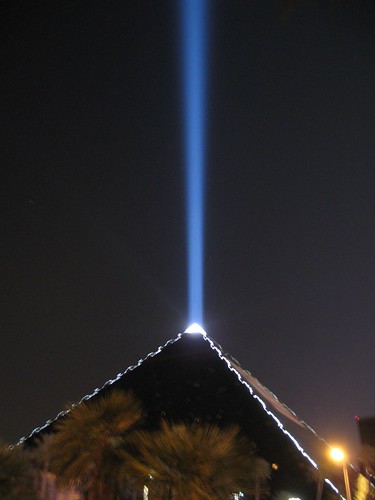
Have any of you ever been to Las Vegas before? Well, for those of you who haven’t, one of the many hotels there is called the Luxor and it’s built to resemble one of the Great Pyramids of Egypt. Except this one has a giant laser light bulb that shines out the top of it and can be seen from SPACE. FROM SPACE. I think I have a picture of it for you. Now that is a bright bright light. It’s so bright that the darkness of space is even lessened by it.

Now imagine how much more powerful the Light of Jesus Christ is in your life. His promises of love, of loyalty, of peace, of comfort, all cut through the darkness of your troubled lives, of your unsure future. The light and hope we have in Jesus Christ doesn’t eliminate all of the darkness from our lives, but it keeps it from swallowing us whole. It keeps us from living in fear, as victims, as hopeless creatures. The Light that is Jesus Christ, helps us look towards our futures and say “I am Not Afraid. I have Hope. The Darkness Will Not Devour Me.”

When you go to sleep tonight, when you lay in the darkness of night, think about the other kind of darkness that surrounds you. And let it know that it has been met and defeated by the Light of Christ which is given to us.


Friday, January 23, 2009

Sunday Preview

Hey kiddos...
I'm preaching about Jonah on Sunday, so I thought I'd give you a preview of my sermon.  Cause I know that you're just chomping at the bit to hear another sermon....

Here's the Intro:

My family lived in Houston from the time I was in the second grade until the summer after my freshman year of high school.   We lived in the same house all those years, a red brick, two-story house with tall pine tress in the front, that I can still walk through in my mind (and often still do in my dreams).  I have many memories of that house, but one in particular stands out.  I don’t know how it came up, or why I was thinking about it, but I wandered down the stairs, through the family room and into the kitchen where my mother was doing dishes.  I couldn’t have been older than 8 or 9 when I asked my mother, “Who goes to heaven?”  My poor mother.  Luckily my mom is quick on her feet and bought herself some time to think by asking me a question: “Why do you ask?”  Now, if you know me, my answer won’t surprise you one bit.  So I told her, “I don’t want anybody to go to hell.”  It galled me to think that people were being punished even if they’d never heard about Jesus.  I was starting to feel the weight of the world on my shoulders and it hurt.  And then my mother said something very complicated to me: “Well honey, we believe that Jesus is the way.  But I have a feeling that God will honor the faithfulness of those who don’t know about Jesus.  God’s really the one who decides all that.”

God decides all that.  Not the easiest answer.  Not even the most comforting answer.  But ultimately true to what we find in scripture both in the Romans passage we heard earlier and in Jonah today.  We find Jonah at the end of the drama: after he’s been thrown up on the beach by a fish; after he’s been tossed off a boat by pagan sailors who seem to understand the will of God better than he; after all the attempts to get out of God’s explicit instructions.  We find Jonah, pouting because God has done something outrageous – he’s decided to forgive.  And not just anybody.  He’s decided to forgive Nineveh – crummy, scummy, sinful Nineveh.  Long-standing mortal enemy of Israel, Nineveh.  And that’s it for Jonah.  The Final Straw has been broken.  He’d like to die now please.

Because Jonah understands Mercy (Israel gets it all the time).  But this is just too much.  God has gone too far.  It’s Too Much Mercy!

Saturday, October 18, 2008

My Sermon on Noah - October 19th

In seminary, I learn a lot of depressing history: crusades, inquisitions, witch hunts, murders, rape, pillaging. Though there are a few bright sprinklings of virtue scattered throughout our common past, mostly there are a lot of stories that make you shake your head in shame. Thankfully, however, it isn’t just Christian history that is full of faux-pas and foolishness: World, American and even Texas history have their own collection of shameful stories. For those of you non-Texans who got educated somewhere else, every 7th grade child has to take a semester long class specifically focused on Texas history – well I did anyway. And do you know what I remember most distinctly? The Alamo. To be specific, the embarrassing rout of a loss that the Texan army suffered at the hands of the Mexican army. What a debacle! Only a few hundred men, holed up in a mission facing the full force of the Mexican army (which was several thousand men stronger than them). After a couple of days of desperate fighting, the men of the Alamo (including Davy Crockett and Jim Bowie) were slaughtered. What fools these mortals be. Did they think they would actually win the day against a fully invested army? Their deaths should have been in vain. But as it turns out, the Battle of the Alamo was more important than you could imagine.
And that’s usually the way it is, no? The most seemingly insignificant battles, the least predictable plans, the most average men are usually the ones who yield surprising gains.
Take the story of our friend Noah, for instance. Here’s something that should have never worked. All we know about Noah is that he’s not as debauched as the rest of the world and so God tells him, sight unseen, to build a very very big boat. What foolishness! How will a big boat make any difference? But as we learn from today’s’ text: God’s Plans Are Never As Foolish As They Seem.
Though I will admit that sometimes God isn’t really very forthcoming or clear about his goals, he’s not a fool. And he’s not blind either. As we open the story today, God has seen what was once good transform into something totally different. God sees, then and now, the corruption of the earth.
But hey, you say, corruption and decay are sometimes the result of natural causes! True – fruit, meat, bread, they will all be corrupted by time if nothing else. But some corruption takes work. Like rust. Now imagine a newly smithied axe bladed. You can flick the metal with your fingertips and it sings. The blade edge is so sharp that a single hair is cut in half on it. Many a poor tree will fall victim to the bite of this axe. But say, for instance, that you left this axe out one night. And it rained. The next morning, when you retrieve it, it seems no worse for the wear. Nor Harm, No Foul, right? Wrong. You see, water is made of hydrogen and oxygen. And when oxygen bonds with iron, something new is made – Ferrous Oxide. Rust. You don’t realize it, but that blade has already been corrupted at it’s deepest and simplest level. It just isn’t show yet. But when it does show, it will be too late. The blade will seemingly be beyond repair.
And that seems to be the case in the story today. Not to say that God has chosen to negligently leave us out in the rain – but that these newly smithied axes seem to have minds and legs of their own. Whatever started the corruption in these people we can’t know. And the point is moot because the corruption of mankind has become so deep that its showing up everywhere.
Notice though, that the text doesn’t explain their corruption. Listen to verse 5 once again “The LORD saw how great man's wickedness on the earth had become, and that every inclination of the thoughts of his heart was only evil all the time.” Now remember that the stories which we have received in the forms of these books were originally the shared stories of the people of Israel. Whenever the father or mother of the clan of Israel would begin this tale, the family would listen closely with heart and mind. And they probably, like we all do, like children do, filled in the gaps. The story trusts that you will be able to imagine what a corruption so great, a wickedness so pervasive that every single thought of the persons heart was evil, looks like. Are you imagining? Can you imagine this world? The people of Israel could. They had experienced slavery and exile, death on scales so large has to boggle the mind, the encroaching terrors of ravenous armies, the destructive force of corrupt and idolatrous kings. They hear wickedness and they remember the past and so in some ways, God’s decision to “wipe mankind, whom I have created, from the face of the earth—men and animals, and creatures that move along the ground, and birds of the air.” They know what it is like for God to say to them “for I am grieved that I have made them.” The corruption here is not explained – it is only seen.
Well, you are probably thinking, I’m glad we didn’t have to suffer through a long and embarrassing list of the “sins” of the people that God was displeased with. That would be uncomfortable. Lets change the wording here and see if we can approximate for ourselves what it would be like to hear this story originally. Lets try to fill in our gaps. “Now the LORD saw how great man’s wickedness in America had become, and that every inclination of the thoughts of their hearts were only evil all the time.” What is your first thought- the thing you immediately identify as evil, as corruption as wickedness. One more time. “Now the LORD saw how great man’s wickedness in Lakewood Christian Church had become, and that every inclination of the thoughts of their hearts were only evil all the time.” What sin did you think of then? What wickedness first came to your mind? I ask you to do these things to make a point – we never think that we’re the sinful people, the corrupt people, the bad people in the story. I don’t want to dwell here too long, but I think that its important to note that God’s not blind to us, to our faults, to our corruption. We worship a God who sees. We worship a God powerful enough to see rust on a blade and figure out how to reverse the process.
Our God, the seeing, powerful God, doesn’t become impotent when he sees corruption- He makes plans for the future. And those plans usually involve us. You see, our God is a productive God, and a God that seeks to work with us. Even when it means that God asks us to build what we have never seen.
They weren’t a very large group of people. Several couples began to meet and to talk and to pray together – thought they still didn’t know why, they were all feeling the weight of God’s Spirit upon them to give themselves over to God’s coming future. They felt the voice of God in their lives, and that voice was very specifically saying, “Build My Church.” I can’t tell you for sure, But I am almost positive that God commanded them to also fill that church with all types of people: the young and old, teenaged and aged, families and singles (at least 7 of each kind). But they didn’t know what that would look like, where it would be, when it would happen. All the details were yet to be given, though the command was clear – “Build My Church.” And who was God asking to build without blueprints? You might recognize a few of the names: Francis Adams, Jim Tom & Shari Speer. These small few were the charter members, the founders of Lakewood Christian Church. These folks stand in a proud tradition of the faithful – those who have responded to God’s call to build the unseen and the unknown – Just like Noah.
Don’t believe me? Ok. Please think for me of all the Bible stories about Israelite ship-builders. Got any? That’s because there weren’t any. Chances are, if they rode on one, they’d paid the passage rather than the construction fees. The people of God weren’t a sea-faring people, so when God asks Noah to build an Ark, chances are that Noah’s first question would be “What’s an Ark?” Of the various other flood narratives that have been found in hundreds of other Mediterranean cultures, Noah is the only one who is neither a navigator, sea-farer or ship-builder. So, God has to be specific for him: make yourself an ark of cypress wood; make rooms in it and coat it with pitch inside and out. This is how you are to build it: The ark is to be 450 feet long, 75 feet wide and 45 feet high. Make a roof for it and finish the ark to within 18 inches of the top. Put a door in the side of the ark and make lower, middle and upper decks.” Maybe Noah was a craftsman who knew how to build. Maybe he was a farmer who kept livestock and raised wheat. Maybe he was a blacksmith. Or a cobbler. We don’t know. All we know is that he’s righteous amongst all the wickedness and that’s qualification enough for God to ask him to build the ark. I’m going to say that again – Noah’s righteousness is all the qualification that God needs for Noah to build the Ark; for Noah to be a participant in God’s plan for cleansing and salvation. All Noah has to do is say yes.
God hasn’t stopped making plans, and he definitely hasn’t stopped getting us on board with those plans. Noah said yes; the charter members of Lakewood said yes. And they said yes with little or no information to go on. “Build” God said, and build they did. What plans is God trying to get you involved with? What are the terrifying and mysterious building projects that God has for your life? In my own life, God has asked me to commit myself to full time ministry. I don’t know where that will go through or where it will end – I just had to commit sight unseen. In your life, God is calling still, I am sure of it. Maybe he’s put it on your heart to care for and minister to the poor or the homeless or the drug addicted. Maybe he’s stirred your soul to spread the gospel not only to your neighbors in Robinson but also to your neighbors in Africa, Asia or South America. Maybe God has been whispering in your ear spurring you to plant a church. Only you can know what God’s call is for you. I beg you, though; don’t let fear of the unknown keep you from acting. Don’t let the grim spectre of failure and mockery and disbelief stall your forward motion. You may appear to be making a foolish investment in God – but I promise, investing your self in God’s plans is the best bet you could ever make.
I never claimed, though, that God’s requests and commands were easily followed. In fact, sometimes it just takes trust on our parts…oh and one other thing: God’s plans require us to be obedient!
I have a cat. He eats when he wants, he goes to the bathroom on his own schedule and sleeps whenever he pleases. As cat people well know, you can’t (or shouldn’t try anyway) to train a cat. Dogs though, can be. To my surprise, a dog can not only sit, stay and heel but can be trained to speak, attack and to fetch your mountain dews from the refrigerator. If you would like proof, there is a very funny video on YouTube that proves my point. Dogs seem to respond well to obedience training – a firm voice and hand can produce extremely well behaved and helpful companions. Dogs can learn to be obedient with just a little hard work and determination. Humans, though, seem more like cats – likely to resist all attempts at obedience training. To test this theory, I dare you to find a 2 or 3 year old child after church (we have a few) and try to order them into doing something they’d rather not. And please, video tape this. We’d all like to congratulate you if it works. We humans are stubborn animals, content to fail or succeed on our own with no help from any of you folks thank you very much. But that doesn’t always work out for the best, especially when we should be minding our p’s and q’s around God.
So how does Noah respond to God’s call to build an ark? Verse 22 says “Noah did everything just as God commanded him.” That’s it. In fact, if you search through the following 3 chapters, Noah actually has absolutely NO dialogue at all until the very end. And then he dies. Noah doesn’t seem to be a man of questions like Moses will be, or a shirker like Abraham will be or even a wrestler like Jacob ends up. Noah just does. He just obeys. He doesn’t deal or cajole or whine or yell – he does everything just as God commanded him. Noah builds an Ark for the first time, gathers more animals than a zookeeper has to deal with for the first time, lives with his sons and their wives during a great supernatural catastrophe – there were lots of times when he could have said – “that’s it God – what the heck is going on?!” But he doesn’t. He obeys. Again and again and again, he obeys God, be trusts God, he worships God. His level of obedience is remarkable, especially considering what he was asked to do. I have a very active imagination, and I can just see what the conversation between Noah and his wife was like.

NW: “How was your day Noah?”
N: “Fine. Oh – I almost forgot. God talked to me today.”
NW: “Did he?”
N: “Yup. I was startled too.”
NW: “Well?”
N: “Well what?”
NW: “What did God say to you?”
N: “Oh, right. He wants me to build an ark and fill it with animals cause he’s going to flood the earth and destroy the wicked.”
NW: “Is that so.”
N: “Apparently. When are we eating?”

That’s probably exaggerating a bit, but remember that Noah’s obedience to God’s plan, Noah’s obedience to this project that would appear to be insane to everyone else, would affect his family as well. For however long it took Noah to build this Ark, his family would be working with him. For however long it took Noah to build this Ark, his family would be judged by him. For however long it took Noah to obediently fulfill God’s plan, they would all appear as insane as him. This level of obedience – it’s costly.
Are you ready for this level of costly obedience? Are you ready to invest not only your money and time, but your whole life and the lives of your family in God’s plans for you? Sure, you say. I’m just waiting for God to reveal his plan for you. Well, good news folks. God’s got another investment program going on that he’d like you to be a part of. He wants you, your time, your money and your family to be totally and completely sold-out committed to this project. Don’t worry – the building is already built, but it’s got some programs that he needs you to be devoted to. The world may think you’re a fool for being invested in this plan – it means that sometimes you’ll miss football games and soccer tournaments; it means that sometimes you’ll drive a little more and spend more on gas than you’d planned; it means your kids will hang out with and spiritually grow with peers that they wouldn’t meet otherwise; it means that you’ll focus on the spiritual needs of others rather than your own material desires; it means you will sacrifice for strangers who might never say thank you; it means you follow a strict code of righteous living instead of the easier life of casual sinning. What’s this plan? Well, you’re sitting in it. Think of Lakewood Christian Church as your own personal ark. We don’t know what God’s total plan for this church is – but knowing the whole scheme was never ours to ask for. As God said to those original members, he says to you still: Build my church. Give not only money, but time, your whole self, your family and friends – dedicate yourself to this church, to God’s church wherever that is. And be obedient to God’s plan even when it sounds crazy, foolish and risky.
Foolish, crazy, risky. Remember the Alamo? I told you that that terrible and humiliating loss was actually one of the most important events in the Texas War for Independence. Why you say? They were fools for standing against that huge army. They were crazy for thinking they could make a difference. They took a risk and they failed. Well…sort of. Those men did die. They did lose that battle. But the news of that defeat sparked a fire in the rest of the freedom fighters; “Remember the Alamo” they said to each other. Remember the men who fought and died for our independence. And they did – the Battle at Alamo became the rallying point for the men and women of Texas, uniting the disparate factions of the independence movement; and you know what – they won. We stand here today a state of the United States instead of Mexico because of the men who lost at the Alamo. They were fools – they shouldn’t have made a difference to anything or anybody. But they did. Their foolishness was wisdom in the end.
Let that be our cry as well: “Remember Noah. Remember the Ark.” Remember that Noah built that which he had never seen, that he obeyed when he had no reason to know that he would be the savior and surviving link for the people of God. Remember that God sees clearly, plans wisely and expects obedience from us. Today is your chance to invest yourself in the Foolishness of God. Today is your chance to dedicate your life to the building up of the Kingdom of God, which we have never seen but yearn for in our deepest hearts. Remember that what seems crazy and risky now can be the turning point, the catalyst for great change, for great grace, for the movement of God’s spirit in the World, in Waco, Texas. Whenever you become afraid, whenever you become cynical, whenever you start to doubt, remember that God’s Plans Are Never As Foolish As They Seem.

Saturday, August 23, 2008

Sermon - August 24th

This is what I'll be preaching tomorrow in church. Thank you for your prayers and encouragements.
------------
Our world is increasingly digital. We buy clothes, books, movies and music online. We pay our electric bills, our credit card bills and our car notes at a computer. We have email addresses, instant messenger identities and chat room names. Our information goes streaming all over the web in mere seconds – credit card numbers, social security numbers, phone numbers, addresses, and even our mother’s maiden name. In such a suspicious world, we make ourselves vulnerable online and in fact, most of us are cases of identity theft waiting to happen. Identity theft is a fairly new but terribly heinous crime – so terrible that now almost all banks and credit card companies offer “Identity Theft Protection”, promising to keep us safe from those criminals who seek to steal our credit card numbers, social security numbers and even our names to acquire whatever they want. Whether they’re hackers or opportunists – petty criminals who pick up our left behind account information – they steal your identity, perpetrate fraud, spend your cash and leave you to deal with the circumstances. They ruin your credit. They steal your name, your self, and violate it. They damage your identity. The mere idea of identity theft fills me with fear – I’ve worked long and hard on who I am. I don’t want to have to be afraid that someone can, without caring, steal that which is at the core of who I am. My identity is important to me. I imagine your identity is important to you to. And it is to your parents. And was to your grandparents. And to their grandparents as well. Throughout the ages, no matter the culture or country, WHO we are is primary. And when I say that, I don’t mean the color of our skin or the pigment of our eyes – I mean the core of our self: our names, our history, our choices and values. We cannot be understood if our WHO remains hidden. We cannot connect to people if their WHO is concealed or forbidden. WHO is the foundation of all relationships whether loving or bitter.
The question we come to today in our scripture reading, is a question of WHO as well – of identity and what that means. Jesus asks his disciples – WHO do you say that I am – and the answer isn’t apparent in the beginning. Why is the WHO so important when it comes to Jesus? Because the answer changes everything. Jesus has been doing some miraculous things already – healing the sick, casting out demon, feeding the thousands with only a few fishes and loaves, even raising the dead. Jesus must be a powerful man, but it still isn’t clear WHO he is! The WHO question reveals more questions – why is he doing these things? What are his motivations? What are his ambitions? Why is he teaching this way? Why should his opinions and interpretations matter more than the opinions and interpretations of the Pharisees or Sadducees or even the average first century Jew?
The question of “WHO Jesus is” is the foundational question of our faith. Everything we are, everything we believe, everything we do in the name of God, we do because of WHO Jesus is. And in the gospel of Matthew this morning, we learn once again WHO it is that we call upon and are saved by.

In the beginning out our passage today, Jesus asks who people say that the Son of Man is. To strip away the cryptic language, Jesus is asking who people say that He is. And the first thing that comes up is a prophet.
For us, the word prophet conjures up many images. I think of the charlatan psychics like Ms. Cleo who come on late night tv and plead with you to part with your money for their “predictions” of your future. Or I think of the wild-haired, crazed homeless men or women who hold up signs predicting the ominous and fiery future of our “fallen” culture. “Repent” they always say “or perish.” There are other kinds of modern day “prophets”, however. Take for instance, Li Edelkoort. Ms. Edelkoort is a Dutch business woman who has been a ‘prophet’ of some renowned for over 30 years. With a list of over 2000 clients including some of the top fashion houses of the world, she makes a business about predicting the futures of fashion, food and pop culture. She is a prophet of trends. And she claims to have always had the ability to predict how the fickle world of popular culture would wend. Every year she sends out booklets to her clients, booklets that contain swatches, colors and patterns of her predictions for the fashion world; these books cost 2000 euros – close to 4000 American dollars - each. When she was asked about what fashion would look like in 2009, she said to expect more color and patterns; she hesitated, though, in her explanation, saying that she and her apprentices were already done with 2009 – they were already working on their predictions for the food, fashion and pop culture world of 2010. Not only is she a year ahead – she’s predicting two years in the future; and the stunning thing is that her predictions are always right on the money. She may not really be a prophet – but she’s close enough.
But our idea of prophet and the New Testament understanding of prophet are quite different. Think back to the prophets that we know in the Old Testament – Moses was considered to be the greatest; there’s Jonah, Hosea, Malachi, Isaiah, Jeremiah…none of them are government leaders or priests. Their power comes from God directly – they received no ordination from men, no election by committee – they speak the Word of the Lord directly to the people no matter if the Word spoken is happy, sad or Hell Fire Condemnation! And usually it was the latter of those. It may be hard for us to understand, but the prophet stands as one of the most remarkable and powerful people in the Jewish tradition. So in our passage today, when Jesus asks who the people think he is, and the disciples respond back that “Some say John the Baptist; others say Elijah; and still others, Jeremiah or one of the prophets," they’re being generous. They have no other category to put Jesus in – he’s not a government or civil leader, he’s not a Pharisee or Sadducee, he’s addressed as a Rabbi but there’s no proof he had formal training. He’s powerful, mysterious and brilliant – why not a prophet? And even Jesus has hinted at it – he’ll say things later that seem to imply he’s like a prophet – only more. Only better. Only more important.
It would be easy for us to be like those first century Jews who first came in contact with Jesus: to acknowledge that Jesus is remarkable but to cop out by calling him a prophet. Jesus was like the prophets of old (and not so old – John the Baptist was his contemporary) but he was more and by limiting him to that prophet status, the people of Israel were limiting who Jesus was and the power he could have over their lives. How many times do you do this – let Jesus be a really cool dead guy who did cool stuff but who has no relevance for you anymore? Give Jesus a little bit of honor – he must be just as important as Moses or Jeremiah – but you don’t give him all the honor of God incarnate who walks and breathes among us? How are you limiting the identity of Christ in your life? Do you let him rule your mind, body and soul? Do you let his teachings guide all of your decisions? Do you let his crucifixion, resurrection and ascension transform your soul? Or do you talk about him in the past tense? Do you relegate him to “awesome guy in the past” status? Do you equate him with other leaders – Moses, Jeremiah, Mohammed, Buddha? Do you? Because if you do – you’re missing it just like the people of Jesus’ time were; you’ve only gotten part of the picture.

But the next part of our gospel reading today gives us more of that picture – by Peter’s confession. And Peter’s confession is a startling revelation about who Jesus of Nazareth really is.
When I was a junior in high school, my English class read through several internationally acclaimed novels – The Joy Luck Club, The Picture of Dorian Gray, Siddhartha, Kokoro and a novel I will never forget: Alexander Solzhenitsyn’s One Day in the Life of Ivan Denisovitch. I remember it so vividly because of how cold it made me feel. One Day in the Life of Ivan Denisovitch was a fiction novel about prisoners of war and government dissidents who were sent to Siberian gulags in Stalinist Russia. Many times, the prisoners would be forced into heavy labor in the most extreme of weather – they only got to stay in out of the cold if the temperature was below negative 70. Otherwise, they were expected to work or be killed. Solzhenitsyn’s novel could have been just a negative portrayal of Stalin’s regime, except for the fact that it was based on his own experiences in Stalin’s labor camps. The publication of this novel was like setting off a bomb in the Kremlin in Moscow – Alexander Solzhenitsyn became an enemy of the communist regime and like other dissidents was hounded and persecuted by Stalin and Kruschev’s governments. He just recently passed away, a hero to the Russian people, an acclaimed novelist and speaker, praised for his bravery and skill. At his funeral, young man said that because of Solzhenitsyn’s bravery in the face of the terrible and corrupt totalitarian government, He was “our Savior…the savior of our morals, our dignity, our consciousness.”
Savior…Messiah. The words mean the same thing. And yet, they mean so many different things. Was Jesus a Messiah, a Savior like Solzhenitsyn was? Was Jesus a Messiah, a Savior, even in the way that the Jewish people were expecting? Savior? From what? From who? To what?
Listen again to today’s scripture: "But what about you?" Jesus asked. "Who do you say I am?" Simon Peter answered, "You are the Christ, the Son of the living God." Jesus replied, "Blessed are you, Simon son of Jonah, for this was not revealed to you by man, but by my Father in heaven.” If you’ve been in a Christian church long enough, you’ve heard this word before “Christ” and by now it’s become inseparable from Jesus. This wasn’t always the case; you see, Christ is not Jesus’ last name – it’s a title. The word Christ, though, is a Greek transliteration of an Aramaic word – messiah. And Messiah means something very distinctive to the Jewish people. To understand messiah, though, you have to remember the past of the people of Israel. They were wandering tribes first. And then enslaved for centuries. Once they were free, they conquered Canaan but weren’t united under a king until 1000BC by Saul, then David and finally Solomon. And then the kingdom split into Judah and Israel. Wars ensued. Israel was destroyed, then Judah, the Jewish people alternately slaughtered or sent into exile. Some returned to Jerusalem, but always ruled over by another king, emperor or dictator. But always, there was a promise of vindication, restoration, reconciliation. Whispers of prophecies circled through the Jewish people – they would be restored; God’s chosen people would once again be free from oppressors, a savior would come to defeat their enemies and restore them. A savior would come – a messiah would come. He had come. The Messiah – the Christ was finally come. Though…not in the way he had been expected. And Peter, Simon Peter who walked on water then sank, will be called Satan by Jesus…the least likely of them all understands who Jesus is – the Christ, the Son of the Living God.
We’ve all had lives like Peter; we think we have faith but it turns out to be not enough. We try to understand what we’re taught but we always miss the mark. We can’t even fish right – strangers have to help us. And yet, Peter, flawed and sometimes dense Peter, recognizes Jesus before anyone else. And why? Because God the Father revealed it to him. So it is with our God. There are some things in life that are too strange, are too wild, are to improbable for us to come up with on our own. And what is stranger, wilder or more improbable that Jesus of Nazareth, the tradesman and itinerant rabbi, being God incarnate? What is stranger, wilder or more improbable than Jesus of Nazareth being the long-expected Savior of not only the Jewish people, but of the world? Our God is a Strange God. A Wild God. An Improbable God. He parts seas, sends plagues, creates life, destroys worlds, anoints foreign kings, exiles his people and chooses to be born into first century Palestine surrounded by animal feed, ne’er do-well shepherds and unwed mothers. We’re like Peter – this is all too hard for us to get on our own. And so God gives it to us; he whispers in our ears, hhe roars like the ocean and he thunders across the skies “Jesus is the Christ – the Son of the living God!”

The passage today ends strangely, though. Jesus praises Peter and invests him with “keys” to God’s coming kingdom. And then tells the disciples to keep his “Christ” status a secret. Why? Wouldn’t he want everyone to know? Why is he trying to keep his identity a secret?
Ever since Spiderman came out in May of 2002, summers seem to be filled with movies about Superheroes. Don’t believe me? Think about it – Spiderman, Spiderman II, Spiderman III, Batman Begins, The Dark Knight, Superman Returns, The Punisher, Ghost Rider, Iron Man, The Hulk, The Incredible Hulk, The Incredible, Aliens vs. Predator, Catwoman, The Fantastic Four, The Fantastic Four 2, Hellboy, Hellboy 2…. the list goes on. And what do Superheroes (or Super Villains for that matter) have in common? Their need for a secret identity. The secret identity is necessary because it protects their families and friends from evil retribution, but it also freed the heroes from expectations being loaded upon them. They weren’t available for consultation, they didn’t ask permission to do what they did or to be who they were. Bruce Wayne could be Batman, Clark Kent could be Superman because they didn’t have to consult with higher powers about how and WHO they were supposed to be. Imagine your favorite superheroes, laden down with other peoples expectations about how they should do what they do, and you can imagine a crippled, inefficient not-so-superhero. Secret identities, secret lairs, secret tricks and technology – they seem elitist and exclusive, but the real point is protection and freedom. Sometimes, any information is too much for some people. These heroes have to be able to do their jobs and they can’t do it if we’re interfering.
Jesus wasn’t a superhero with powers from Krypton or wherever, but he was a powerful man with supernatural abilities and a growing reputation. He needed freedom to move, teach and act according to plan, and he couldn’t do that if WHO he was got broadcast all over Israel. He had to remain a secret for a bit longer. Why?
I mentioned earlier that the people of Israel had been anticipating the arrival of their ‘messiah’ their promised savior for hundreds of years. They had many expectations about WHO he was going to be, how he was going to act and what he was going to do to redeem Israel. And none of those expectations had anything to do with crucifixion. One of the most prevalent ideas about the Messiah was that he would be a military leader, a fierce warrior who would lead Israel into battle against the Roman Empire and would restore her to rightful place as an independent nation. Many people heard Messiah and saw visions of battle, heard the plaintive cries of their dying enemies and could almost taste the sweet wine of victory. And Jesus knew that. He knew that having his identity as the promised Messiah broadcast across Palestine would hinder more than hurt him and disappoint thousands. But it’s more than just that. For the people to really understand what Messiah meant, the crucifixion and resurrection would have to come first. Because Jesus as Messiah necessitated the crucifixion – that’s how he would save Israel and the whole world! That’s how he would redeem the lost and exiled faithful! That’s how he would establish a new kingdom on earth! Messiah is not Messiah without death and resurrection. Messiah is not Messiah without the pain of loss and the unexpected joy of renewed life. And so Jesus asked for secrecy. IT was too soon to reveal his cards. IT was too soon to announce his true name. It was too soon for people to hear. They had to wait. They had to suffer. And then it would all be made clear. Jesus full identity would be laid out.
We are not so different from the faithful Jews of Jesus’ time. We have expectations about how Jesus will be and what he will do and how he will do it. He’ll come riding out of the clouds and strike down the unbelievers! NO…he’ll come like a thief and shame all of those who weren’t living the way they were supposed to! NO…he’ll appear to our president and say “America was always my favorite country. Three cheers for democracy!” NO…he’ll come back and condemn America for being sinful! NO….it goes on and on and on. The tough news, folks, is that Jesus will NEVER be what you want him to be. He’ll never say what you want him to say, He’ll never act like you want him to, He’ll never befriend who you think he should. Jesus is the Messiah, the Christ as God the Father called him to be. He eats with tax collectors and prostitutes, he condemns the rich for caring more about their well-being than the well-being of their neighbors, he restores the demon-possessed (even if he’s a Gentile), and he drank wine and probably danced at weddings. We, just like the first century Jews, the first Christian churches, have to understand Jesus not just as a teacher, or a tradesman or a prophet or a man of social justice – but as the Messiah who was born of a virgin, who was God in human form, who was crucified and resurrected. Only then do we really know him. Only then do we really understand our own faith. Only then do our practices and doctrines and bible studies and fellowship gatherings really make sense. Jesus is prophet, messiah, Lord – and because we come after the fact, we have the benefit of a full and glorious picture. Not that we really understand it though.

Jesus had to admonish his disciples – Don’t Tell. It wasn’t out of shame or a desire to get more attention or even because he was unsure himself. It was out of necessity. The story wasn’t finished yet. The cross had not been reached. Wait. Be patient. “Who do you say that I am?” Now, though, we have a different commandment – Tell. The story is fulfilled – death has been defeated, life has been restored, reconciliation is possible! The Messiah has come and you know what that means! Not a political leader! Not a military leader! But God has come in the Flesh and established a kingdom. His identity is no longer a secret! When you eat together, Jesus is the Christ. When you sing together – Jesus is the Christ. When you mourn together, weep together, laugh together, lover together – Jesus is the Christ. The foundation of all of this, of this church, of our lives, of our futures finds its anchor in the Identity of Jesus of Nazareth – Christ, Messiah, Savior, God. Go – Tell. He died for all. He was raised for all. And he waits for you still.